Justice Thomas’s Defense of Inalienable Rights Vexes Progressives
by John D. O’Connor
The following is an article originally published on American Greatness. Read it HERE.
__________________
Justice Thomas reminds us that the Declaration’s promise of God-given rights—not rule by progressive “experts”—made America worth striving to perfect.
As we near our country’s 250th anniversary of the Declaration of Independence, one would think all Americans, however politically divided, would agree that its ringing words, invoking Creator-endowed inalienable rights, should be applauded. But if you think this is one document upon which we can all agree, think again.
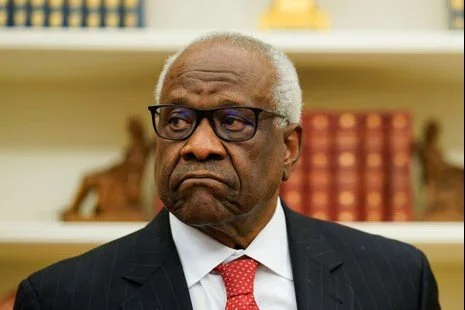
At the University of Texas School of Law, Justice Clarence Thomas beautifully spoke to the hope these words have long given to the country’s disadvantaged black community, both when enslaved and decades following. But as the “Progressive” era beckoned around the turn of the century, this hope was not fulfilled, as, per just one example, the Supreme Court in Plessy v. Ferguson (1896) embodied the “separate but equal” doctrine in preference to the lone “color-blind constitution” dissent of Justice John Marshall Harlan. Thomas noted that it took 60 years to reverse that hated “separate but equal” doctrine, referring to Brown v. Board of Education in 1954.
During the advent of Darwinism, the promise of the Declaration of Independence gave way to progressivism, embodied most prominently in the thinking of our 28th president, Woodrow Wilson. Of course, Thomas didn’t claim that Wilson “invented” progressivism.
Thomas was certainly correct in claiming that Wilson did not think highly of the Declaration of Independence. He was also correct that Wilson was a huge fan of Germany’s top-down administrative state, praising its efficiency, speed, and use of bureaucratic “experts.”
Two corollaries of Wilson’s progressivism were described by Thomas as “retrogressive.” First, Wilson’s resegregation of the government and the military, and his effective ban on blacks in civil service, were quickly implemented. Secondly, Wilson sought to avoid the messy and slow democratic process of obtaining voter consent and began building the administrative state of rule by educated intelligentsia.
Thomas also alluded to the concurrent Buck v. Bell opinion, allowing the government to involuntarily sterilize those deemed so eloquently by the great progressive jurist, Oliver Wendell Holmes, to be “imbeciles.” And, yes, eugenics in general was advocated by progressives, as it was contended that inferior bloodlines were polluting our population. Progressive Margaret Sanger promoted abortion as a way to rid our country of inferior races.
It was not Justice Thomas’s purpose to vilify any particular politician or party but merely to caution our country about that strain of thought that considers government to be the source of all rights at its discretion, not bound to cherish inalienable rights possessed by each of God’s creatures.
One would expect, of course, that today’s progressives would agree with (and compliment) Justice Thomas, presumably dismissing Wilson’s policies as a long-outdated remnant of the past. But tellingly, this was not how today’s progressives reacted to his speech. After all, these broad ideas of Justice Thomas touched a progressive nerve, precisely because the ideas he criticized were not relics of the past but, rather, alive and, unfortunately, well today.
Accordingly, progressive media sites lashed out with an ad hominem viciousness that would have made Saul Alinsky blush.
Matt Ford at The New Republic took Thomas to task for claiming, Ford deemed falsely, that Woodrow Wilson had “invented” progressivism:
Presenting Wilson as the inventor of progressivism is historically illiterate, akin to saying that Joseph Stalin invented communism or that Ronald Reagan invented conservatism.
Of course, as many of the other sites correctly note, progressivism was the confluence of several strands of thought starting in the late 1800s as corrective measures to the perceived failings of the free market. Some pointed to Theodore Roosevelt’s presidency, which indeed implemented strands of progressivism, advocating greater governmental oversight, regulatory “trust-busting” power, and other consumer protections we think of today as being “liberal” more than Progressive.
But if we’re counting, fourteen years before Roosevelt’s presidency, Wilson wrote “The Study of Administration,” an article published in the Political Science Quarterly Journal in 1887, becoming the most prominent early sponsor of the most menacing and uncontrollable strand of progressivism, the technocratic administrative state, praising the administration of German Chancellor Bismarck.
One outlet attempted to distance Wilson from Bismarck by correctly claiming that Wilson said he would adapt Bismarck’s system to a country larger and more diverse than Germany. This trifling distinction, of course, can be marked down to the narcissism of fine differences.
An opinion piece in The Wall Street Journal demonized Thomas for “denouncing millions of his fellow Americans,” when in fact he was not denouncing anyone but rather a set of principles that dishonored the sanctity of those very same citizens.
Part of the Thomas speech that angered progressives was the connection he drew between progressive thought and the soul-enslaving policies of Stalin, Hitler, Mussolini, and Mao. This language offended UC Berkeley Law Dean Erwin Chemerinsky, who sought to cleave progressivism from fascism, even though he conceded that “some” progressives favored eugenics.
While Thomas argued that progressivism had roots in common with fascism, Chemerinsky retorted that fascism was “anti-socialist.” Professor Chemerinsky may wish to note that the word “Nazi” is short for “national socialist.” Defining away the ugly racism underlying progressivism, the professor argued that Wilson was the “least progressive” president on race, ignoring the broader point that progressives today, through the same cynical thinking, use race as simply another dehumanizing political weapon.
But Chemerinsky goes further than arguing (counterfactually) that Thomas was inaccurate. He claims a Supreme Court Justice has no business praising the Declaration in a “deeply polarized” country. Apparently, his criticism of divisive speech did not cause him to comment adversely when three major left-leaning media outlets had covers with caricatures depicting Trump as Hitler. Chemerinsky’s piece can thus be considered a form of progressive cancel culture.
Speaking of Hitler, it is a historical fact that he was greatly influenced by the American eugenics movement, a logical outgrowth of the social Darwinism central to the Progressive movement. Progressives today ignore that their intellectual forebears, like Walter Lippmann, had an early infatuation with the Nazi leader.
In any case, the segregationist Wilson was indeed a prominent progressive. But did his segregation policies stem from an aversion to the Declaration of Independence? It most certainly did, as shown by his arrogant dismissal of this revered text:
No doubt a great deal of nonsense has been talked about the inalienable rights of the individual . . . and a great deal that was mere vague sentiment and pleasing speculation has been put forward as a fundamental principle.
Yes, this prominent promoter of progressivism thought little of the rights of American citizens. Indeed, Wilson very much disliked our Constitution and the messy, slow process it entailed. He found citizen voters as a whole to be “selfish, ignorant, timid, stubborn, and foolish.” As Thomas pointed out so astutely, “Wilson lamented that we do too much by vote and too little by expertise.”
But don’t today’s progressives have the defense that this astutely accurate rendition of Wilson’s views is nothing more than a historic relic? One needs only look to today’s administrative overreach, combined with cruel abandonment of the most important needs of underprivileged racial minorities.
In 2009, an overweening progressive administration issued a “Greenhouse Gas Endangerment Finding,” giving the EPA regulatory control over . . . carbon dioxide! Yes—the “dangerous” gas that every animal on Earth constantly emits and every plant constantly inhales and is also constantly released by millions of tons of rotting biomass worldwide. This absurd finding, of course, gave the government control over our cars, gas stoves, gas fireplaces, fossil fuel production, heating systems, and, of course, manufacturing plants and oil refineries, driving up costs and “affordability” problems trickling down to all sectors, including food production. A tomato requires the equivalent of approximately five tablespoons of diesel fuel in energy to reach the consumer.
And with the unionization of government employees, “progress” from the prior limitation of unions to private industry, blue-state minorities are trapped in a dysfunctional educational system with collective bargaining driving up the cost of tenured teachers and preventing underperforming teachers from being easily dismissed. The progressive darling, teachers’ unions, has also effectively limited charter schools, vouchers, and school choice, mainly in blue states where underprivileged minorities need them desperately.
In contrast to the experience of many minority students today, several young black men were sponsored for enrollment at Holy Cross College in 1968 through a recruitment campaign driven by Jesuit Fr. John E. Brooks, with financial aid from alumni like the prominent lawyer Edwin Bennett Williams. Although these young men received financial aid, they did well academically on their own merits and became highly successful after graduation. One of the more prominent of these is Justice Clarence Thomas himself, who descended from a sharecropper and became a justice of the United States Supreme Court.
On our 250th anniversary of the luminous Declaration of Independence, we should be loudly applauding Clarence Thomas as a pride of our country. But instead, progressives are taking ignorant potshots at this fine man, seeking, as Saul Alinsky would cheer for, his personal destruction, falsely claiming his ahistorical stupidities.
Let’s all take a moment to thank this great man for the courage of his conviction in defending the spiritual root of our freedoms; cherish the optimism inherent in the Declaration of Independence; and bask in patriotic pride.